
Pokaz mody
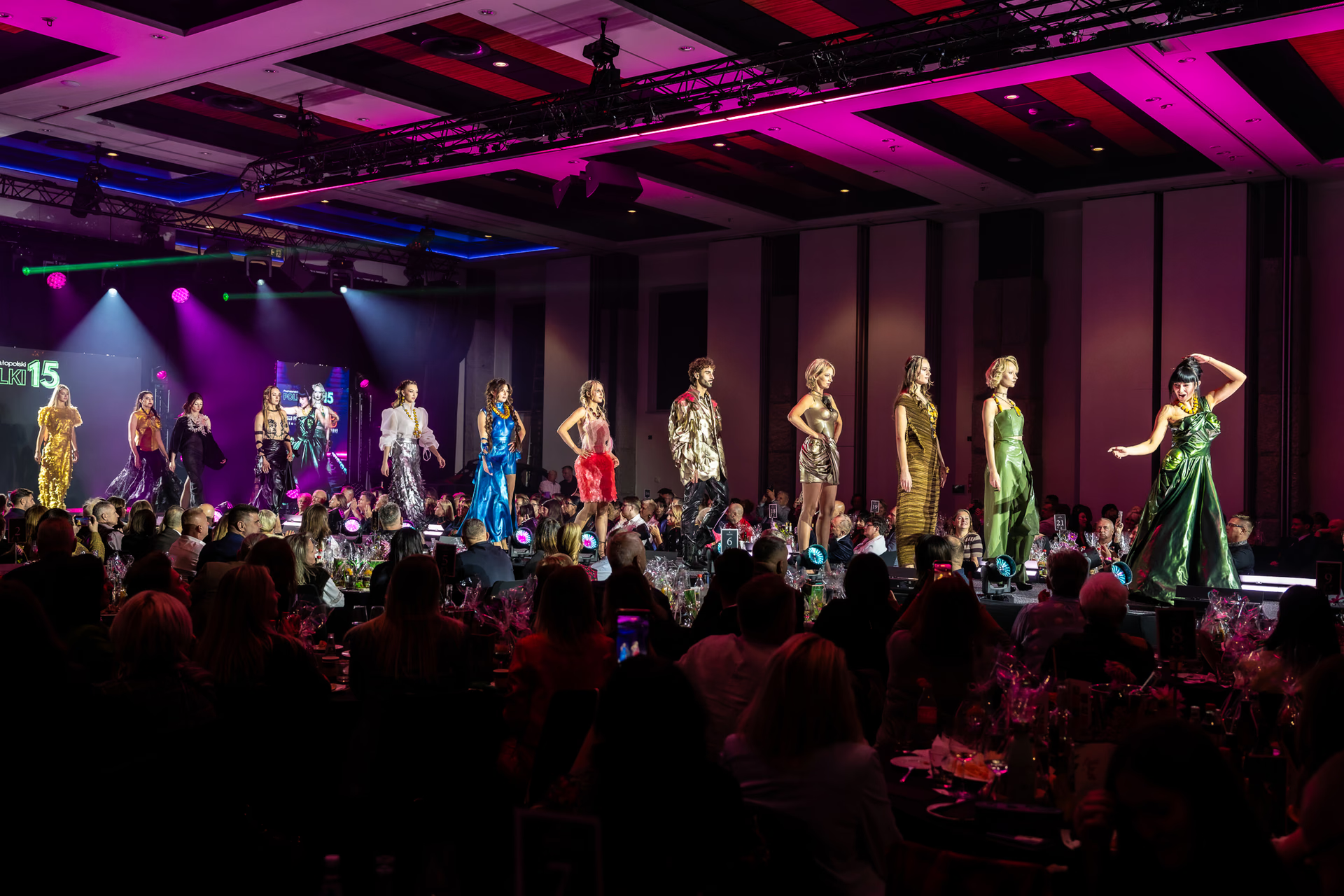
Polki Folki 15 Fashion Show in Zakopane
Twelve fashion shows, seven live acts, and a hotel congress hall where we had to mic everything from a DJ to a crystal harp. At the 15th anniversary edition of Polki Folki at Nosalowy Dwór, lighting, sound, and LED screens were all on us.
- Year
- 2026
- Venue
- Nosalowy Dwór Resort & SPA, Zakopane
- Client
- Fundacja „Made in Podhale“
Scope of work
- Lighting
- Sound
- Multimedia & AV
- Visuals
- Stage construction
The brief: everything the room hears and sees
Polki Folki is a folklore-inspired fashion show that the Made in Podhale Foundation has been staging in Zakopane for fifteen years. It was created by designer Aneta Larysa Knap from Nowy Targ. The anniversary edition took place on October 30, 2026, in the Gerlach hall at the Nosalowy Dwór hotel, under the theme "Podhale Forest and Treasures of Małopolska."
The program was packed. Twelve designers and brands showed their collections, and between the shows the stage went to musicians including Zora, Marta Bejma, Duet z Pienin, Słovianki Słowiańska Krew, and Bogusław Nawara. Alongside the models, the runway featured the Women of Passion (Kobiety Pasji), among them Edyta Golec, Aga Dyk, and Dominika Ćosić. The evening was hosted by Magdalena Pecka.
We had worked with the foundation before, and this time we again handled all the technical production: lighting, sound, LED screens, and part of the content shown on them. Every change to the run of show went to one crew instead of three companies.
Time: a short load-in window
Productions like this never have much time. In a short window we had to fly 85 m of truss, the PA, lights, and screens, and build the runway on top of that, so everything moved fast. Our crew has done plenty of equally demanding events. Everyone knew what to do, nobody wasted time, and the whole load-in ran smoothly.
Sound: L-Acoustics L2D in a congress hall
The Gerlach is a congress hall, not a concert venue. Guests sit at tables, some right by the runway, some by the back wall. The system has to sound the same for both, and the front can't get blasted just so the back can hear something.
We went with L-Acoustics L2D, one element per side. L2D is a single box from the L Series, but inside it has four modules set in a fixed, progressive curvature. One element gives 60° of vertical coverage, so in a room this size there was no need to build a full array. The two lower modules widen the horizontal coverage from 110° to 140° and cover the guests sitting closest. The top two have Panflex, so we set the horizontal pattern to fit the room, not the other way around.
Before anything went up, the crew modeled the room in Soundvision, L-Acoustics' coverage modeling software. That's how we work on every job: model first, then motors. Soundvision shows how the system will sound at the front table and by the back wall before the first box comes off the truck.
Each L2D needs 16 amplifier channels and 16 DSP channels. They were driven by an LA-RAK III, which houses three LA7.16 amplified controllers, with a single cable running to each box.
The low end came from four KS28 subwoofers, each with two 18" drivers and extension down to 25 Hz, powered by an LA12X. Four X12s were flown from the ceiling: two aimed at the stage, two at the runway and the tables next to it. The entire main system, amplification included, was L-Acoustics.
Few companies in Poland own an L2 system. At outdoor events such as Pabianice Days, we run it in full L2 and L2D arrays. Polki Folki showed the other side of the L Series: a single L2D per side in a hotel hall for several hundred guests, with tables set right next to the runway.
Crystal harp, violin, and open mics
Much of the music at Polki Folki is acoustic. The instruments on stage included a crystal harp, Duet z Pienin played violin and accordion, and Bogusław Nawara played bagpipes and folk pipes. Sources like these are quiet, so the mic has to sit close to the instrument. In a congress hall the PA hangs just a few meters from the stage, which is a straight path to feedback.
This is where the L2D design helped. The element has integrated cardioid control, so far less sound goes backward toward the stage and the open mics. We could push the instruments up in the mix without fighting for every decibel.
The instruments were miked with DPA 4099 miniature mics mounted directly on the instrument. Musicians play the way they always do, and the mic stays at the same distance from the source the whole time. DJ Lupo ran through DI boxes, and we mixed the whole show on an Allen & Heath dLive C3500 with a CDM64 MixRack.
Wireless: Sennheiser Spectera
Handheld mics and Sennheiser HSP4 headsets ran on Spectera, which fits every link into one wideband channel instead of a dozen narrow ones and encrypts the entire signal. With more than a dozen changeovers in one evening, we had one fixed band to plan and watch instead of a dozen separate frequencies.
What helped us a lot was that a single Spectera bodypack handles a mic and in-ear monitoring at the same time. The performer wears one device instead of two, and we have less gear to clip on, check, and charge before each entrance. With this many changes in the program, that made our job much easier.
We also have SKM handheld transmitters for Spectera. On this job we added more mics with a Shure QLX-D system.
Runway and lighting
At a fashion show the audience is looking at the clothes, and photographers shoot from several spots in the room at once. Embroidery, tulle, and wool shawls need to look in photos the way they look in the studio, along the entire runway, not just at its end.
The runway was built from 15 Nivtec 2×1 m stage decks. Above the room, 85 m of aluminum quad truss flew on 16 electric chain hoists, loaded with plenty of lighting fixtures.
XEOS Stager 160 CYC HCR: our new fixtures
Sixteen of our new XEOS Stager 160 CYC HCR fixtures worked this show. XEOS is the brand of Polish distributor Prolight, and the 160 CYC HCR joined its lineup in September 2026. The fixture is built to light large surfaces evenly. White can be set anywhere from 1,800 K to 10,000 K, and the CCS 3.0 system keeps every unit putting out the same color. With sixteen fixtures in one frame, that matters: the photo shows one shade, not sixteen similar ones. At Polki Folki the Stagers stood on both sides of the runway, between the MAC Ones, and lit the models from below. Front light came from above, so each model was lit evenly, without harsh shadows, along the whole runway.
ACME Pixel Line IP battens also hung on the truss above the runway.
The MAC Ones along the runway marked its edges. In green, to match the forest theme, they turned the runway into a corridor of light visible from every table. Beams from the moving heads on the truss, including Prolights Astra Spot and ADJ Vizi Beam units, reached toward the stage. An MDG haze generator with a fan added a light haze: enough to show the beams, without filling the room with smoke.
Zactrack followed the models walking the runway, with no followspot operator needed. We programmed the whole show on grandMA3.
LED screens and content
The LED screens, at a 2.5 mm pixel pitch, added up to 27 m²: a wide screen at center stage and vertical ones on the sides. Tables sat right by the runway, and at this pitch the image doesn't break up into pixels even from the front rows. The signal ran from a media server through two Novastar VX1000 processors.
We produced part of the content ourselves: the Podhale forest background and the base screen layout. The visuals for individual collections came from outside our team.
Equipment
Sound
- 2× L-Acoustics L2D on L2 frames
- 4× L-Acoustics KS28
- 4× L-Acoustics X12
- L-Acoustics amplification: LA-RAK III (3× LA7.16) and LA12X
- CLAMP250
- 4× Electro-Voice Everse 8
- Allen & Heath dLive with CDM64 MixRack
- Sennheiser Spectera with 4× HSP4
- Shure QLX-D
- 4× DPA 4099 and a DPA drum mic kit
- DI boxes, Hollyland intercom, fiber, power distribution, and full cabling
Lighting and rigging
- 24× Martin MAC One
- 24× ACME Pixel Line
- 16× XEOS Stager 160 CYC HCR
- 12× Brighter X-Dot
- 8× Brighter X-Dot Max
- 8× Brighter X Profile
- 8× Prolights Astra Spot
- 8× ADJ Vizi Beam
- 6× Prolights Sunblast
- Zactrack
- grandMA3 console
- MDG haze generator with fan
- 85 m of aluminum quad truss and 16 electric chain hoists with a 16-channel controller
- Runway built from 15 Nivtec 2×1 m decks
By the numbers
- Program: 12 fashion shows and 7 musical performances in one evening, several hundred guests at tables
- Crew: 8 people, including sound, lighting, and video operators plus technicians
- Lighting: 114 fixtures on 85 m of truss
- Sound: 2× L2D and 4× KS28, the entire main system from L-Acoustics
- Screens: 27 m² of LED, with part of the content produced in-house
The result
The evening ran to plan, from the opening to the closing Folk Design show featuring salt crystals from the Wieliczka Salt Mine. On our side there were no technical problems and no downtime. After the show, Aneta Larysa Knap told Podhale24 that she builds the event from backstage out, because at events billed as professional she had seen too many shortcomings. Tech is the part of backstage that guests aren't supposed to notice.
Photos: Paweł Kos Fotografia
Planning a fashion show or a gala in a hotel?
A runway, more than a dozen stage changes in one night, and a congress hall instead of a concert venue: we know this setup well. Tell us what your evening's program looks like, and we'll match the tech to the room and the run of show.